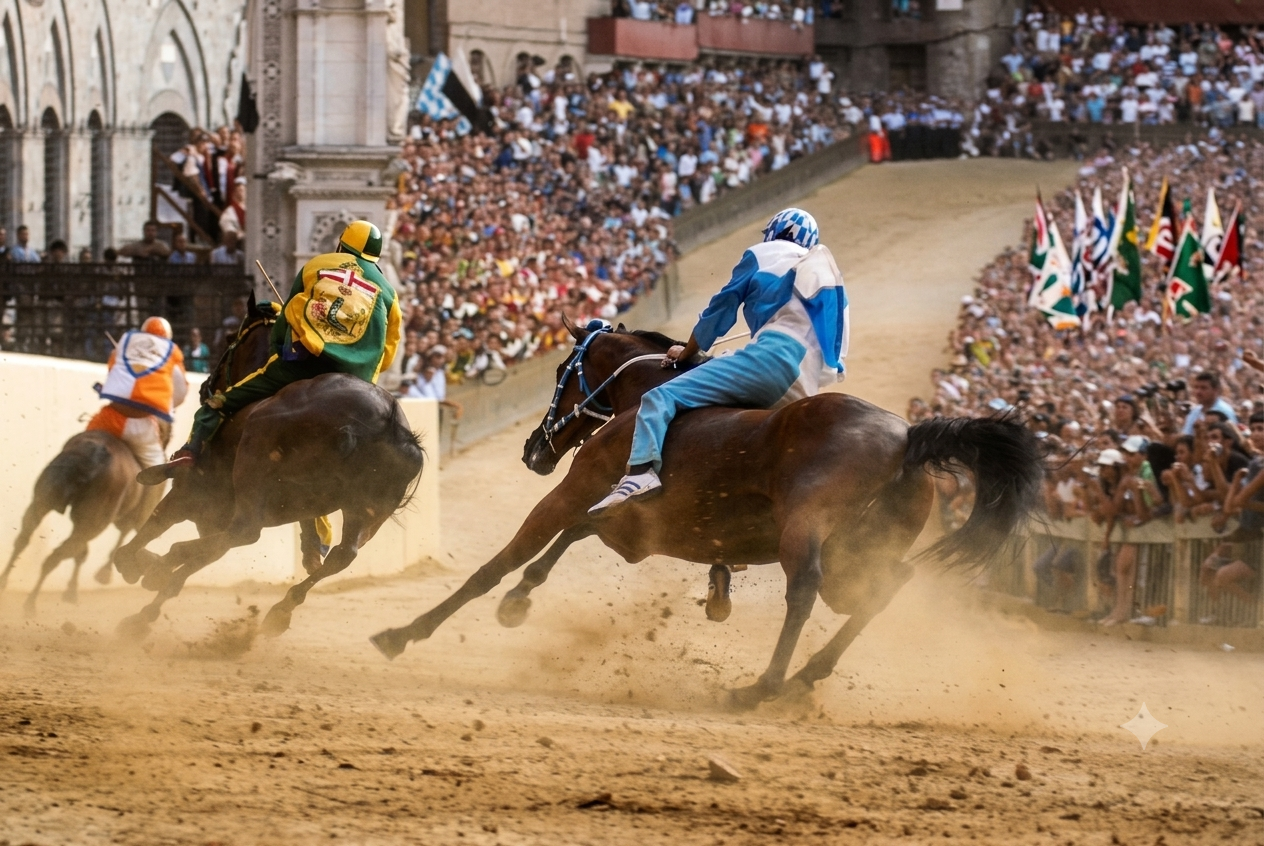
What It's Really Like to Live the Palio di Siena, Told by the People Who Run It
For seventeen Contrade, the historic neighbourhoods of Siena, the Palio is not a tourist spectacle. It is the organizing principle of an entire year. Long before the horses enter Piazza del Campo on 2 July or 16 August, the contradaioli (members of a Contrada) have already lived through months of anticipation, tension, and ritual that outsiders rarely see.
Born Into a Colour
Most Sienese don't choose their Contrada, they're born into it, baptized into it in a literal ceremony at the neighbourhood fountain, and carry its colours for life. Marrying into a rival Contrada, or worse, cheering for one, is treated as a minor betrayal at the dinner table. This isn't folklore performed for cameras, it's identity. A contradaiolo will tell you they feel the Palio "in their stomach" days before the race, a knot of anxiety that has nothing to do with tourism and everything to do with seventeen intertwined family histories.
The Days Before: Trial Runs and Sleepless Nights
In the days leading up to each Palio, six trial races (prove) are run in Piazza del Campo, practical for the jockeys and horses, but emotionally exhausting for residents. Contrada members gather nightly for communal dinners in the streets, sitting at long tables that stretch for blocks, sharing food prepared by neighbours who've become an extended family. These dinners are where strategy is whispered, alliances between Contrade are negotiated, and rival jockeys' payments are debated in hushed, half-joking tones. Nobody outside the Contrada is meant to fully understand what's said, and that secrecy is part of the thrill.
For help planning how many nights to stay in Siena, see our arrival and departure guide.
The Race Itself: 90 Seconds That Feel Like a Lifetime
The race lasts around ninety seconds. For participants, it is the culmination of a year of savings (Contrade often spend enormous sums to secure a competitive horse and jockey), of ceremonies, blessings of the horse inside the neighbourhood church, and of nervous energy that has been building since the tratta, the drawing of horses, days earlier. When their horse crosses the line first, grown adults openly weep, strangers become instant family, and celebrations can last for weeks, culminating in a nocturnal victory dinner that draws thousands.
For the Contrade who don't win, disappointment can be sharp, but it's already being redirected toward next year's tratta. In Siena, there is no off-season for hope.
What Visitors Sense, Even From a Grandstand
You don't need to be born into a Contrada to feel the intensity. Watching from a reserved seat in Piazza del Campo, visitors often describe the same thing: the crowd's silence just before the starting rope drops, then the deafening roar as ten horses launch bareback around the piazza's brutal, banked curves. It's one of the few traditions in Europe that has resisted commercialization almost entirely, no sponsors' logos, no scripted pageantry beyond the genuinely historic Corteo Storico procession in medieval costume.
Why the Palio Still Matters Today
In an era when so many "authentic" European festivals have been reshaped for Instagram, the Palio di Siena remains stubbornly, almost defiantly, local. That authenticity is exactly why demand for good seating fills up months in advance, reserved grandstand seats and private balconies overlooking Piazza del Campo are limited by the physical size of a 13th-century square that was never built with tourism in mind.
If experiencing this raw, centuries-old rivalry from a proper vantage point, rather than standing for hours in the crowded centre of the piazza, is on your list, planning ahead isn't optional; it's essential.