Walking on Wisdom: Siena Cathedral, Its Marble Floor and the City Behind the Palio
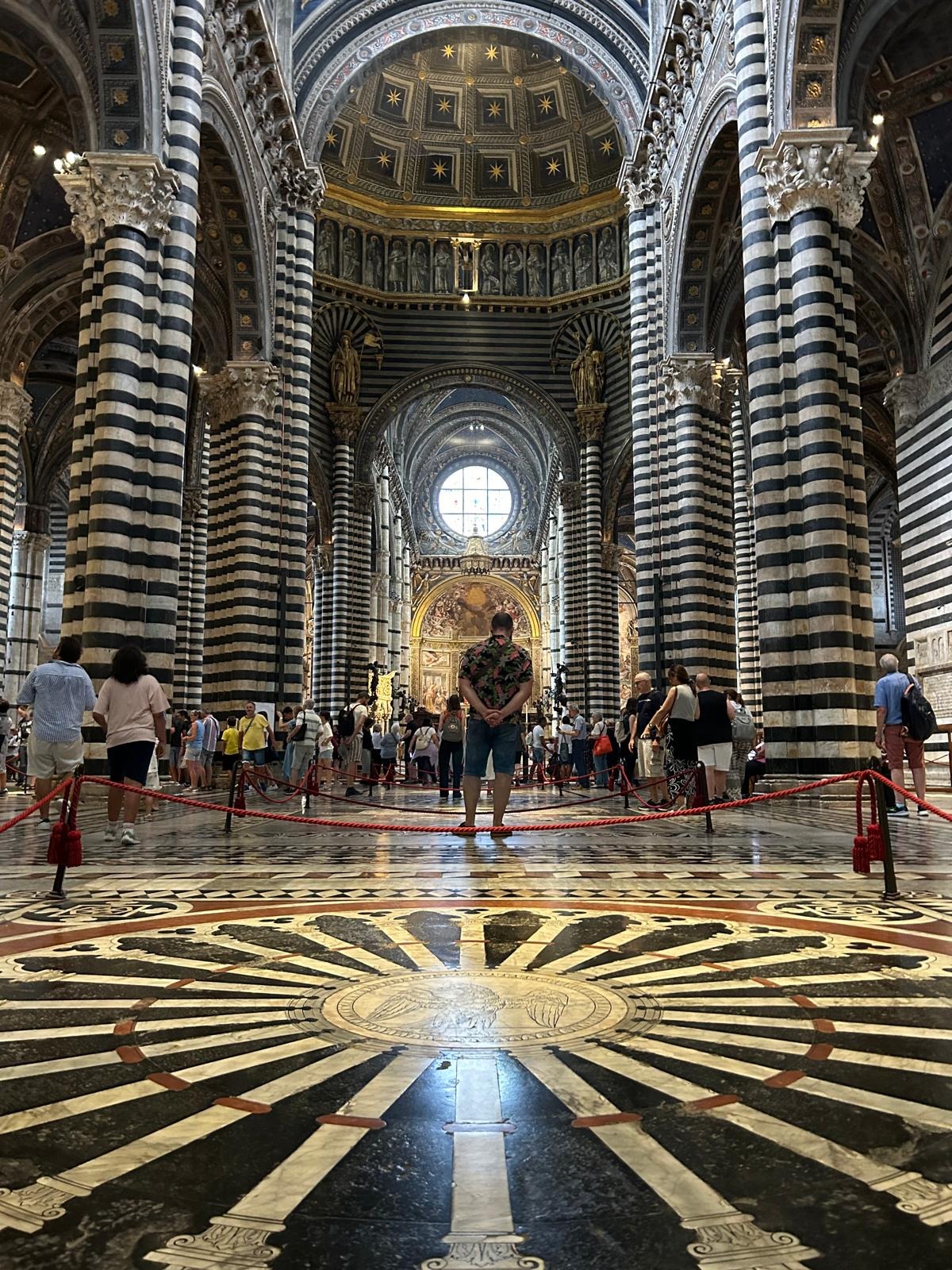
Siena Cathedral’s floor is one of the most ambitious works of art in Italy: 56 marble panels created between the 14th and 19th centuries, with much of the cycle protected by coverings outside its unveiling periods. For 2026, the official openings are 27 June–31 July and 18 August–15 November—not a fixed calendar for every year. Looking closely at this pavement is also a way to understand the city behind the Palio.
Most visitors arrive in Siena thinking of one thing: horses circling Piazza del Campo. Then they walk uphill, step through the cathedral doors and look down. Under their feet is a story told in marble that took centuries to complete.
This is another Siena, beyond the race itself. The city that poured its pride into the cathedral still expresses its identity through its contrade, banners and traditions. Understanding one makes the other more vivid.
A cathedral that expresses Siena’s ambition
Siena Cathedral, dedicated to Santa Maria Assunta, is both a place of worship and a statement of civic identity. Its striped marble columns, sculptured façade and richly decorated interior make clear how much the city invested in its cathedral.
Look around before concentrating on the floor. The black-and-white contrasts, the height of the nave and the works gathered around it give the pavement its setting: this is not an isolated museum piece, but part of a living sacred building.
The dedication to the Virgin of the Assumption matters for the rest of this story. Siena’s August Palio honours the Assumption too, connecting the cathedral with the city’s religious and civic life.
The Siena Cathedral floor Vasari admired
The cycle consists of 56 marble inlay panels, known in Italian as tarsie. Work extended from the 14th to the 19th century. Giorgio Vasari described the pavement as the “most beautiful…, largest and most magnificent…ever made”.
The designs came from leading artists, overwhelmingly Sienese, with the Umbrian Pinturicchio a notable exception. Matteo di Giovanni and Domenico Beccafumi are among the painters whose ideas were translated into stone by skilled marble workers.
The technique developed over time. Early graffito panels used lines cut into white marble and filled with black stucco. Mosaic marble inlay then brought together coloured pieces of stone, allowing artists to suggest light, shadow and depth. Beccafumi pushed that possibility particularly far.
A journey towards wisdom, told in marble
The floor is not a random gallery. Read as a whole, it leads from the wisdom and prophecies of the ancient world towards biblical revelation. The altar is the destination of this artistic and spiritual journey.
A few panels help make that narrative easier to follow:
- Hermes Trismegistus: near the entrance, the legendary sage introduces the theme of human wisdom.
- The Sibyls: ten prophetesses of the classical world appear along the side aisles, bringing pagan antiquity into the cathedral’s Christian programme.
- The Mount of Wisdom: Pinturicchio’s 1505 design, also called the Hill of Wisdom, turns the pursuit of knowledge into an ascent. The figure of Crates renouncing riches makes the choice between possessions and wisdom visible.
- The Massacre of the Innocents: Matteo di Giovanni’s dramatic scene brings a New Testament episode into a cycle otherwise dominated by classical and Old Testament subjects.
- Moses on Mount Sinai and other biblical scenes: Beccafumi’s work near the altar demonstrates how marble inlay can achieve striking effects of light and shade.
You do not need to identify every figure to enjoy the floor. Start by noticing how each scene is constructed, then follow the connections between the subjects rather than treating the panels as separate pictures.
Siena Cathedral floor: photo gallery
From the cathedral interior to the details of a single marble panel. Select a photograph to view it in full and browse both images.
When is the Siena Cathedral floor uncovered?
Much of the pavement is covered for conservation outside the announced unveiling periods. Earlier years’ summer and autumn openings are useful background, not a reliable calendar for a future trip.
The official 2026 opening dates
The announced 2026 unveiling schedule includes two periods:
| Period | Official dates |
|---|---|
| First unveiling | 27 June–31 July 2026 |
| Second unveiling | 18 August–15 November 2026 |
The second period is an extraordinary extension into November. A description ending in mid-October is therefore not accurate for 2026. Opening hours are reduced from November, and religious services can affect access; check the current official timetable as well as the dates.
Planning for 2027
As of 27 October 2026, a 2027 unveiling calendar had not been confirmed for this guide. Do not carry the 2026 dates forward or treat past years’ opening windows as confirmed 2027 dates. Confirm current opening dates and access conditions directly with the cathedral before booking your visit.
Look up, too: the rest of the cathedral complex
The floor may be the headline, but the cathedral rewards anyone who lifts their eyes.
- The Piccolomini Library: Pinturicchio and his workshop painted scenes from the life of Pope Pius II, surrounded by an elaborate decorated vault.
- Nicola Pisano’s pulpit: a major work of 13th-century sculpture, with crowded narrative reliefs to study at close range.
- The Museo dell’Opera and the Facciatone: another part of the cathedral complex to consider when planning a wider visit.
- The Crypt and Baptistery: separate spaces that add to the artistic story of the site.
Check the current passes and conditions for the rest of the complex and the Porta del Cielo rooftop route. Do not assume every area or timed visit is included in the same admission.
Where Siena Cathedral meets the Palio
The Palio is often described simply as a horse race. Its place in Siena’s religious and civic traditions helps explain why the cathedral belongs in the same story.
The Palio dell’Assunta on 16 August honours the Virgin of the Assumption, to whom the cathedral is dedicated. On 14 August, the city council, the contrade and the parishes take part in the candle-offering tradition associated with the Corteo dei Ceri e dei Censi, whose procession leads towards the cathedral.
These traditions make the cathedral more than a sightseeing stop alongside the race. It is one of the places where Siena expresses the identity that also gives the Palio its meaning.
For the uncovered floor, however, the calendar still matters. In 2026, the 2 July race falls inside the first opening period, while the 16 August race takes place before the second period starts on 18 August. Neither relationship is a guarantee of access on a particular day or in another year.
If you hope to include both the cathedral and the race, our guide to planning the length of a Siena stay around the Palio helps you allow time without treating race day as an ordinary sightseeing day.
Why the cathedral rewards a guided visit
It is possible to pass through the nave without understanding much of what lies underfoot. A guide can help turn the panels into a narrative: why Hermes appears near the entrance, why Wisdom is reached by an ascent, and how the subjects relate to one another across the building.
A guided visit can also connect the cathedral with the historic centre, making the city’s traditions easier to read. Guiding arrangements and admission need to be confirmed separately; a guide’s presence does not itself guarantee uncovered-floor access.
It is the same idea behind our story of Brunelleschi’s dome in Florence: a great monument becomes more meaningful when you understand the human story behind it. Siena’s marble pavement has its own very different story to tell.
See Siena with context
For centuries, Siena has written its faith and civic identity into the cathedral floor. Take time to look down, then look back at the city outside with that story in mind.
If the race is also part of your plans, use our Palio di Siena experience overview to ask about current arrangements. Availability, conditions and each inclusion must be confirmed. Do not assume a Palio package includes cathedral admission, access to the uncovered floor, a licensed guide or a Contrada dinner, or that a driver can enter the historic centre during race-day road closures.
Editorial note
This guide was last checked on . The 2026 dates are not a calendar for later years; confirm current opening and access arrangements directly with the cathedral before visiting.
Frequently asked questions
When is the Siena Cathedral floor uncovered?
The official 2026 unveiling dates are 27 June–31 July and 18 August–15 November. These dates apply to 2026 only; confirm current opening dates and access arrangements with the cathedral before travelling.
Are Siena Cathedral floor opening dates confirmed for 2027?
As of 27 October 2026, the official floor pages checked for this article publish a 2026 schedule, not a 2027 unveiling calendar. Do not assume the same dates will apply in 2027; consult the official calendar before making plans.
Can I see the uncovered floor during the Palio?
In the published 2026 calendar, the 2 July Palio falls within the first unveiling period. The 16 August race falls before the second period begins on 18 August. Check the cathedral’s access arrangements and the calendar for your own year; a Palio visit does not guarantee floor access.
How many panels are there and who designed them?
There are 56 marble inlay panels in a cycle made between the 14th and 19th centuries. The artists include Matteo di Giovanni, Domenico Beccafumi and Pinturicchio, whose Mount of Wisdom design dates to 1505.
What is the connection between Siena Cathedral and the Palio?
Siena Cathedral is dedicated to Santa Maria Assunta, the Virgin of the Assumption, honoured by the 16 August Palio. The city’s August candle-offering procession leads to the cathedral, linking the race to Siena’s religious and civic traditions.
Does a Palio package include admission to Siena Cathedral’s floor?
Do not assume that it does. Cathedral admission, uncovered-floor access, guiding and Palio arrangements have their own conditions. Ask for explicit confirmation of each inclusion and its availability before booking.