Stand in Piazza del Duomo and look up, and it's easy to take the dome for granted. It's been there for six centuries; of course it's there. But for most of the 14th century, that dome existed only as a problem nobody could solve, and the story of how one stubborn, self-taught architect solved it is, in many ways, the story of the Renaissance itself.
It's also the best possible starting point for understanding why Florence is a city that rewards travellers who go beyond the ticket line and into the story.
A cathedral with a hole in the roof for a hundred years
When construction began on Florence's cathedral, Santa Maria del Fiore, at the end of the 13th century, its original architect designed an octagonal space at the heart of the building that was meant to be crowned by an enormous dome. He died without leaving any drawings or instructions for how to actually build it.
For decades, the cathedral sat essentially unfinished, a masterpiece with a hole where its heart should be, because nobody in Florence knew how to close a span that wide without it collapsing under its own weight. The wooden scaffolding needed to support a dome of that size didn't exist, and building it would have required stripping entire forests of timber.
It took a Florentine goldsmith with no formal training as an architect to solve a problem that had stumped the city for a century.
The goldsmith who reinvented architecture
Filippo Brunelleschi trained as a goldsmith, not a builder. After losing a famous competition to design the bronze doors of Florence's Baptistery, he left for Rome with his friend Donatello, where he spent years obsessively measuring the ruins of the Pantheon, trying to understand how the Romans had built domes without modern engineering.
He returned to Florence convinced he had the answer. Convincing anyone else was another matter. When he first proposed his solution at a public assembly in 1420, a dome built with no wooden supports at all, the other architects in the room laughed so hard that he was reportedly carried out, dismissed as a madman.
He got the last word in a much quieter way. Challenged to prove his genius, Brunelleschi took an egg and asked the assembled architects to make it stand upright on a flat table. When they all failed, he simply tapped one end against the surface to flatten it and set it down, balanced. It's a small piece of theatre, but it captures exactly the kind of mind Florence rewarded during the Renaissance: practical, stubborn, and unwilling to accept that "impossible" was the final word.
An engineering trick still studied today
What Brunelleschi built between 1420 and 1436 is still considered the largest masonry dome ever constructed. Instead of one dome, he built two: an inner and an outer shell, connected together and made almost entirely self-supporting through a herringbone brickwork pattern that let each ring hold itself up as it was built, without the timber scaffolding everyone else assumed was necessary.
The dome rises 90 metres above the ground. At its summit sits a lantern, added after Brunelleschi's death from his own designs, topped with a gilded copper ball. Between the two shells, a staircase of 463 steps still carries visitors up to the base of the lantern today, for one of the most complete panoramic views in Florence.
Brunelleschi didn't get to see it finished, but he spent the sixteen years of construction essentially living inside the project: inventing new hoisting machinery, personally inspecting materials, and even installing a canteen so his workers wouldn't waste time climbing down for meals. The same obsessive, hands-on mind also built the Ospedale degli Innocenti and developed the mathematical rules of linear perspective that Renaissance painters relied on for the next 200 years.
Why this story matters more once you're standing in front of it
None of this is obvious from a queue outside the Duomo, or from an audio guide script read at the pace of a hundred other visitors moving past you. The dome, the Baptistery rivalry, the egg and the herringbone brickwork turn "an impressive building" into one of the most human, dramatic stories in art history.
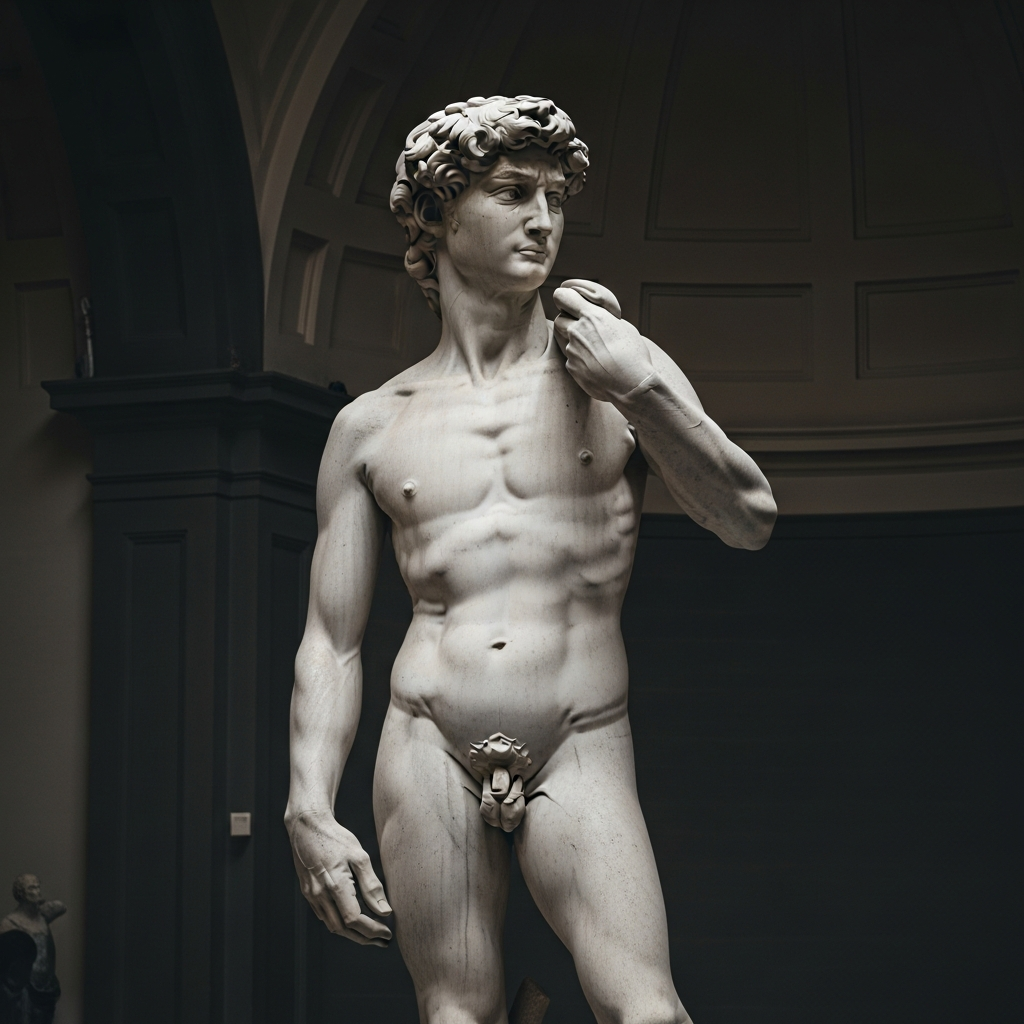
Once you know it, you start noticing the same tension — obsessive craftsmanship, fierce rivalry and individual genius pushing against convention — everywhere else in Florence: in the David a few streets away, in the Uffizi's corridors and in nearly every church façade in the historic centre.
This is exactly the gap a good private guide closes. Not simply unlocking faster access to a museum, but making the Renaissance legible in real time, in front of the actual works, from someone who can connect Brunelleschi's dome to Michelangelo's David and the politics of the Medici family as you walk between them.
See Renaissance Florence with context
Explore a private David and Uffizi experience led by a licensed art historian, with reserved museum admission.
Explore the Private Florence TourTurning the Duomo into the start of a private Renaissance day
This is the experience Italy Spotlight has built around Florence: a private Florence tour of Michelangelo's David and the Uffizi Gallery, led by a licensed private art historian, with reserved museum admission built in so your time in Florence goes toward looking at the art rather than standing in line for it.
The tour is shaped around the Accademia, the Uffizi and your own interests. The Brunelleschi story isn't just background reading; it's the kind of narrative thread a private guide can pick up outside the Duomo and carry all the way to Michelangelo's David, showing how one century of obsessive Florentine ambition led directly to the next.
It's built for travellers who have already seen photos of the dome and the David online and want something those photos can't give them: context, access and a knowledgeable local so the visit becomes a story you can retell, not a stop you can only tick off.
Enquire about the private David and Uffizi tour to check availability for your dates in Florence.
Florence is the start of the trip, not all of it
Florence sits at the centre of a region built for exactly this kind of curiosity, and much of the best of it is a short private-driver transfer away. Italy Spotlight can help organise the wider Tuscany stay around your Florence days:
- Private Tuscany wine tasting with a driver — a half-day or full-day escape into the Chianti countryside.
- Palio di Siena private grandstand experience — for travellers whose stay overlaps with Siena's historic horse race.
- Andrea Bocelli at Teatro del Silenzio — an evening at the open-air amphitheatre near Lajatico, reached by private driver from a Florence base.
The logic connecting all of it is the same one that makes the Duomo story worth knowing before you visit: Tuscany rewards travellers who go in with context and a plan, rather than a checklist. A private guide inside Florence and a private driver for the countryside beyond it turn separate sightseeing stops into a single, well-paced week.
Frequently asked questions
Do I need to book museum tickets separately if I book a private guide through Italy Spotlight?
No. The private David and Uffizi tour is built around reserved museum admission, so entry is included as part of the arrangement rather than something to organise on your own beforehand.
Can the tour focus on the Duomo and Brunelleschi's Dome specifically?
Tours are tailored around your interests. Mention the Duomo and the dome's history when you enquire so the guide can shape the day around that narrative from the start.
Is climbing the 463 steps to the top of the dome part of a private tour?
Access to the dome climb is managed separately by the cathedral authorities and has its own tickets and time slots. Raise it when enquiring so availability can be checked for your dates.
How far in advance should I book a private guide for Florence?
Licensed private art historians and reserved museum slots are limited, especially from spring through autumn. Enquiring as soon as your travel dates are confirmed gives the best chance of matching your preferred day and time.
Can Italy Spotlight also arrange a private driver for day trips outside Florence?
Yes. Private drivers for the Tuscan countryside, Siena and other day trips can be arranged alongside a Florence-based stay. Mention day-trip interests in the same enquiry so the whole stay can be planned together.
Six hundred years after Brunelleschi refused to accept that his dome was impossible, it is still one of the best reasons to see Florence with someone who can explain why it matters. Enquire about a private Florence experience and start planning the Renaissance day the city deserves.